|
Marketing & Storytelling
|
Jun 10, 2026
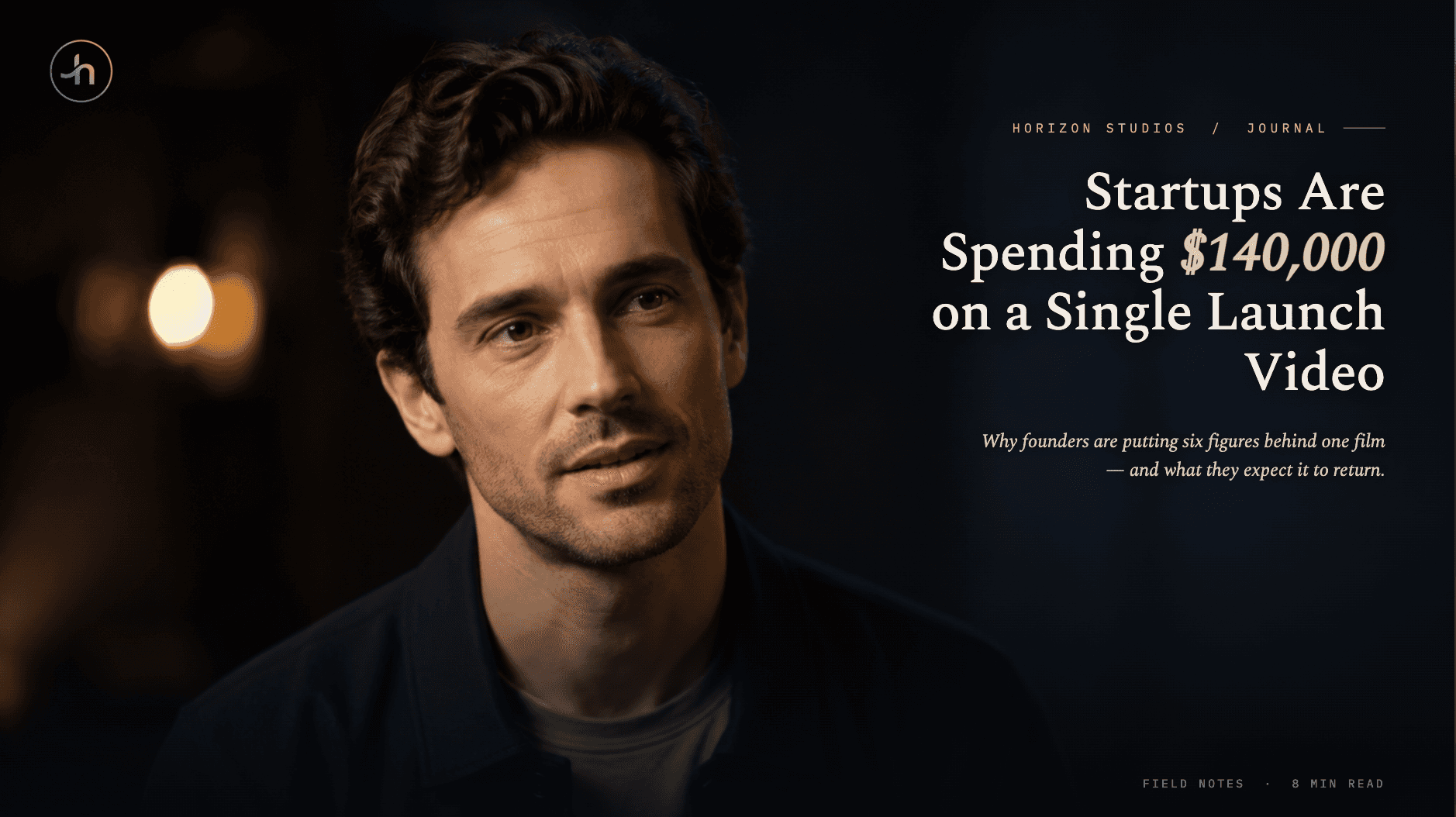
Startups Are Spending $140,000 on a Single Launch Video. Here's Why.
Startups are investing up to $140,000 in a single launch video. Here's what really drives the return, with real examples from Cluely, Dollar Shave Club, and Dropbox.

William Julien
CEO & Creative Director
A decade ago, a startup announced a funding round with a press release and a couple of posts. Today some of them are releasing short films.
When the AI startup Cluely announced its raise, it did not send a tweet thread. It dropped a cinematic launch video that reportedly cost $140,000 to produce, a ninety-second narrative short of a man on a first date being quietly fed lines by the product. The video went viral, crashed the company's servers, and rode the attention into a $15 million round. Cluely is one of a wave of founders, many of them young, who now treat the launch video as the announcement itself rather than an afterthought to it.
At first glance, $140,000 for one video sounds indulgent. The interesting question is not why a company would spend that. It is what return could possibly justify it. The answer is where this gets worth paying attention to.
The real lesson is not the budget. It is the return.
The most valuable startup videos in history were not the most expensive. They were the ones that did a real job at the right moment.
In 2012, Dollar Shave Club launched with a video that cost $4,500 and was shot in a single day. Founder Michael Dubin delivered a deadpan pitch walking through a warehouse, and the thing detonated. The site crashed on launch. Within forty-eight hours the company had twelve thousand orders. The video has since passed twenty-seven million views, and in 2016 Unilever bought the company for roughly a billion dollars. A $4,500 film was the first domino in a billion-dollar outcome.
A few years earlier, Dropbox faced a different problem. Drew Houston had a product that was hard to explain in words and not yet built to scale. Instead of writing whitepapers, he recorded a short demo video showing how seamless file syncing would actually work, seeded it on Hacker News and Digg with jokes written for that exact audience, and pointed viewers to a beta waitlist. The team hoped to nudge the list from five thousand toward fifteen thousand. Overnight it hit seventy-five thousand, with no paid advertising behind it. The video proved the demand before the company had spent the engineering effort to meet it.
Cluely's was a six-figure cinematic production. Dollar Shave Club's was written and performed with real comedic craft. Dropbox's was engineered precisely for the audience it needed to reach. What they shared was not a price point. Every one was made with genuine skill and aimed with intent, and that is what produced the return. The budget was downstream of the craft, not the other way around. The studios and founders behind these videos understood that the asset was worth investing in, and the returns followed.
Why the bar is higher now
There is a catch worth being honest about. The Dollar Shave Club video worked partly because, in 2012, a scrappy and funny startup video was a novelty. Feeds were less crowded, audiences were less saturated, and the format itself was fresh enough to spread on surprise alone.
That world is gone. Audiences in 2026 watch more video than any generation in history and have a sharp, instinctive sense of what is cheap and what is considered. AI tools have flooded every feed with low-effort video, which means the floor is lower and the noise is louder than ever. A clip that would have stood out fifteen years ago now disappears into the scroll.
The effect is that craft matters more, not less. Clearing the noise today takes real production, real direction, and a story built with care, and that takes a real investment of money and attention. A cheap or templated video is a false economy. It rarely builds the trust the research says you need, and it can quietly signal that a company does not take its own story seriously. For a video that has to carry a launch or a raise, that is the most expensive mistake of all.
Why video moves the numbers
There is research underneath this, not just anecdote.
A peer-reviewed study published in Scientific Reports in 2025 examined how video content shapes buying behavior on social platforms. It found that video which is useful, easy to understand, and engaging measurably increases consumer trust, and that trust is the mechanism that drives purchase intention. Video did not push people to buy directly. It earned their trust, and trust moved them to act (Luo et al., 2025).
For an early-stage company, that finding lands hard. Trust is usually the scarcest thing a startup has. Nobody has heard of you, nobody knows whether the product works, and nobody knows whether the founders will still exist in a year. A page of text answers those doubts slowly. A well-made video answers them in the time it takes to watch. It shows the people, the product working, and the reason the company exists, and it does it in a format people are already spending hours a day inside.
One video, many jobs
The six-figure number also looks different once you see how far a single launch film travels. A founder rarely uses a good video once.
The same piece becomes the hero of the website, the centerpiece of an investor update, the LinkedIn post that outperforms a month of text, the asset a salesperson sends to warm a lead, and the thing a candidate watches before deciding to take the meeting. A video made for a launch keeps working long after launch day, across fundraising, sales, recruiting, and press. Spread across all of that, the cost per use stops looking like a splurge and starts looking like infrastructure.
What startups actually spend
Budgets vary widely depending on scope, crew, locations, animation, and how far the video needs to travel. As a rough map of the market:
Video type | Typical range |
|---|---|
Founder story film | $5,000 to $25,000 |
Product demo film | $5,000 to $30,000 |
Brand film | $10,000 to $50,000 |
Product launch video | $10,000 to $75,000 |
Fundraising announcement film | $20,000 to $100,000+ |
Flagship venture-backed launch film | $50,000 to $140,000+ |
Most startups start well below the top of that range, and that is fine. The point is not to spend the most, and it is certainly not to spend the least. It is to invest enough for the video to actually do its job. A seed-stage founder story film and a Series B national launch are different problems with different budgets, and a good studio will tell you which one you actually need and what it will take to do it well.
What this looks like when it is your company
The famous examples make the case in the abstract. Here is what it looks like with companies we have worked with directly.
For Speakology AI, we produced a brand film during their raise. After it went out, their investor reply rate rose by 86 percent, and the round closed at 120 percent above the original ask.
For Flowy AI, an AI sign language recognition platform, we built the launch around a real human moment rather than a feature tour. The film drew more than 350,000 views across social platforms and helped bring over 45,000 demos and new customers onto the platform, with no paid spend behind it.
Fuse AI used their film in investor outreach as part of a successful $3 million seed raise. The brand film we made for the Horological Society of New York premiered at their 160th Anniversary Gala, an event that raised $1.2 million. And when Auxos launched with our film, the founders saw the response they were after, with a strong wave of engagement and a steady run of demos booked off the back of it.
None of these are the results a templated explainer tends to produce. They come from treating the video as a business asset with a job to do, not a line item to minimize.
Frequently asked questions
Why are startups investing more in video? Because attention is scarce and trust is scarcer. Video builds both faster than most formats, and a single film can be reused across fundraising, sales, recruiting, and press.
Does video actually influence buying decisions? Research published in Scientific Reports found that useful, clear, and engaging video raises consumer trust, and that trust directly influences purchase intention (Luo et al., 2025).
What video should a startup make first? For most early-stage companies, a founder story film or a launch film delivers the most value, because both establish credibility and explain why the company exists before asking anyone to buy.
The takeaway
Cluely's $140,000 video is a headline, but the price tag is not the lesson. The lesson is that video is one of the highest-return assets a startup can build. Dollar Shave Club turned a well-crafted launch into the first chapter of a billion-dollar company, and Dropbox turned a sharp demo into seventy thousand signups overnight. What separated them was not how much or how little they spent. It was that each video was made well enough to do its job. In a feed more crowded than it has ever been, doing it well is what produces the return, and that is worth investing in.
If you are planning a launch or a raise and want to talk through what your video should actually do, we are based in San Francisco and Los Angeles. Get in touch.
Sources
Upton-Clark, E. (2025). Startups are ditching LinkedIn for TikTok to announce funding rounds. Fast Company. Reporting on Business Insider's account of Cluely's $140,000 launch video and the broader trend among startups including Hedra, Bland, and Wander.
Inc. (2017). How a $4,500 YouTube Video Turned Into a $1 Billion Company. On Dollar Shave Club's launch video, 12,000 orders in 48 hours, and the 2016 Unilever acquisition.
The Lean Startup and contemporaneous reporting on Dropbox's 2007 demo video and the jump from roughly 5,000 to 75,000 beta signups overnight.
Luo, C., Mohd Hasan, N. A., Ahmad, A. M. Z., & Lei, G. (2025). Influence of short video content on consumers' purchase intentions on social media platforms with trust as a mediator. Scientific Reports, 15, 16605. https://www.nature.com/articles/s41598-025-94994-z
Horizon Studios is a brand film and cinematic video studio for technology companies, based in San Francisco and Los Angeles. Recent work includes Speakology AI, Flowy AI, and Fuse AI. See the full portfolio at horizonstudios.us/projects.
|
Newsletter
|
Monthly updates
Stay in the Loop
Join our Newsletter for insights, design inspiration, and marketing strategies that help modern brands grow.