|
Marketing & Storytelling
|
Jul 19, 2026
We Built a Logo Big Enough to Sit Inside: The Polaris Launch Film
Polaris is a creative companion for people who build imaginary worlds. Novelists, screenwriters, songwriters, concept artists, indie game developers. You talk to it like a collaborator at 2am, and it listens, asks the questions you missed, and remembers your characters, your lore, your voice. Whatever you make stays yours, end-to-end encrypted, never sold, never used to train AI. When the team came to us for a launch film, we hit the problem that defines most software launches. Almost none of that is filmable. There is no interface worth shooting, no feature that photographs, no moment where the product does something a camera can capture. The thing Polaris actually sells is a feeling: privacy, and the trust that comes with it. Our job was to make that feeling legible, and to make it for an audience of working creatives who can spot a generic SaaS ad from across the room. Here is how we did it, and why the approach matters for any founder thinking about how to launch.

William Julien
CEO & Creative Director
Start with the one true thing
Every product has a core idea that everything else hangs from. For Polaris it was the North Star, the fixed point you can always steer back to, and the promise that whatever you create circles only you and stays yours.
We decided not to illustrate that idea. We decided to build it.
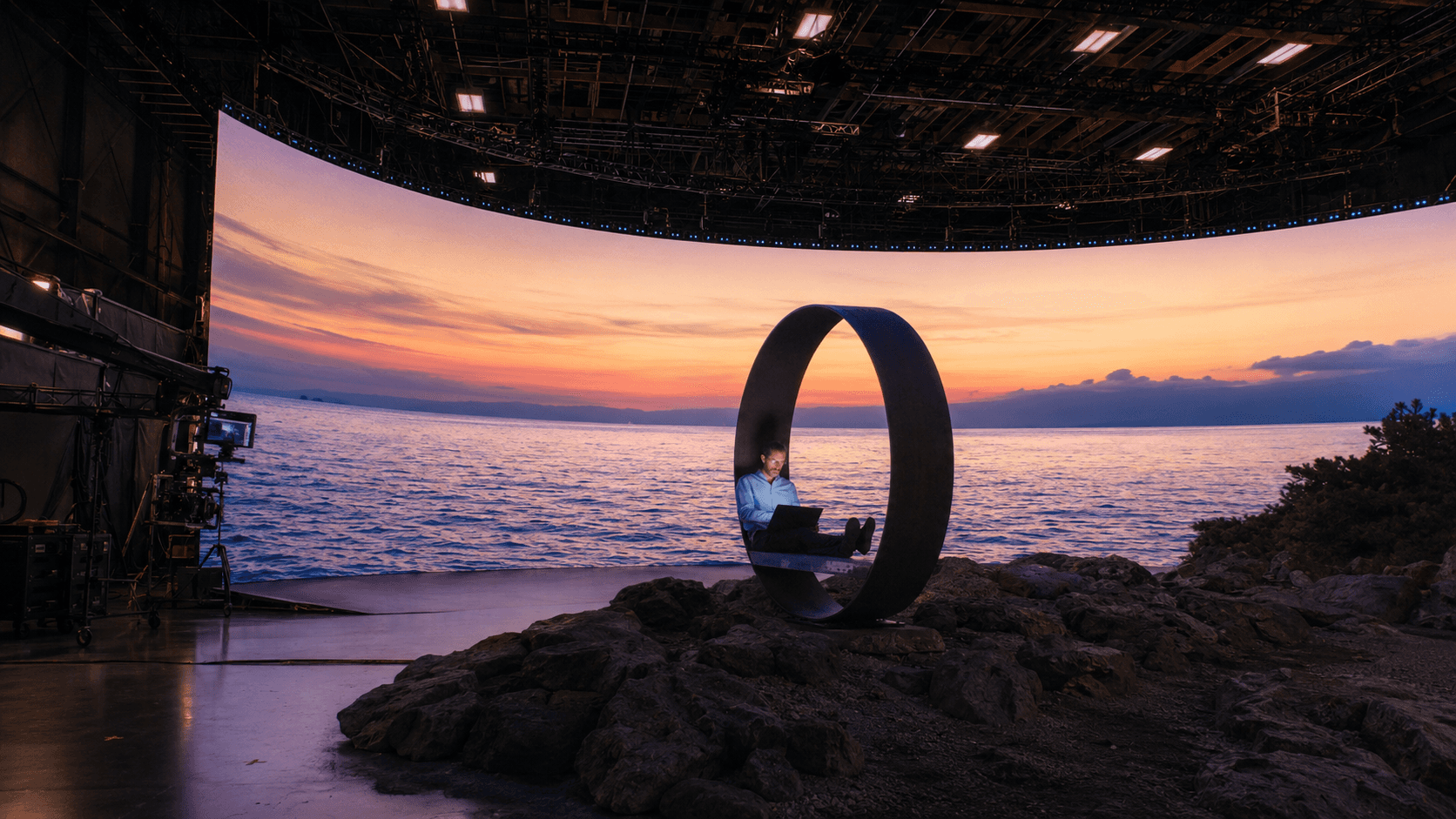
Working with the Polaris team, we shaped the O in the brand mark around a water design at its base, guided by two references. One was the staging of Cirque du Soleil's O in Las Vegas, all water and spectacle. The other was the DreamWorks logo, the small figure fishing on the moon, and the way a single image can hold an entire story. Then we made the O real. Rather than animate it, we fabricated a physical art piece in its shape, large enough for our lead to sit inside with a laptop and actually use Polaris the way a real person would.
That choice changed everything about the film. The logo stopped being a symbol on a screen and became a place a creator lives inside. Which is, more or less, the product itself: a world that grows around you and circles only you. The concept and the craft became the same thing.
Make the invisible visible
The hardest part of the technology to convey was the part that matters most to the audience. Polaris runs on zero-knowledge encryption. The key lives only with the user, and even Polaris cannot read what you make. For a creative deciding whether to trust a tool with unpublished work, that is the whole pitch, and it is completely invisible.
So we built it out of glass. Panels of it surround the subject and shield the work while staying clear enough to let the world behind keep showing through. Protected, but not hidden. It gave an abstract security architecture a physical, emotional form a viewer could feel in a second, without a word of explanation. This is what film can do that a feature list cannot. It turns a technical fact into something you understand with your eyes before your brain catches up.
Build it like a film, not an ad
The production was scaled to match the ambition. A team shot location plates in Prague, chosen for depth and for a beauty that would hold up behind the subject. The foreground was shot on an Arri Alexa Mini LF with Arri Signature full-frame lenses, lit with SkyPanels, then composited into the Prague world and graded. The post work, compositing, color, and 3D animation, was done in-house.
That is a real film pipeline, the kind used for work you would see in a cinema, applied to a startup launch. Not because spectacle is the point, but because the audience was creatives, and creatives can tell instantly whether you respected the craft. The production values were not decoration. They were the argument. A tool for world-builders had to look like it was made by people who take world-building seriously.
The whole thing came together in four weeks.
What it did
The film reached 2.4 million views across YouTube and X.
For a launch, that number is not just a vanity figure. It is a launch that introduced a brand-new product to millions of exactly the right people, in a category where trust is the deciding factor, with a piece of work that made the product feel considered, premium, and safe to hand your unpublished novel to. Reach at that scale, aimed at the right audience, is what gives a young company the oxygen to convert attention into users, and the credibility to walk into other rooms, including investor rooms, already looking like a company that matters.
That is the quiet compounding effect of a launch film done right. The same asset that goes viral on launch day is the one that anchors the website, warms up an investor conversation, and tells a potential hire this is a team worth joining. One film, built once, working across every surface where a startup has to earn belief.
The lesson under the case study
Polaris worked because we did not try to film the software. We found the one true feeling at the center of the product, privacy and the trust it earns, and built the entire film to make that feeling physical. The logo you could sit inside. The glass you could see through but not past. The North Star you could always find.
Most launch videos fail because they try to explain a product. The ones that work make you feel what the product is for. That is the difference between content and a film people believe in, and it is the difference between a launch that fills a feed and one that starts a company.
If you have a launch on the horizon and want a film built to make people believe, we are based in San Francisco and Los Angeles. You can watch the Polaris film on our projects page, or get in touch.
Horizon Studios is a brand film and cinematic video studio for technology companies, based in San Francisco and Los Angeles. Recent work includes Polaris, Speakology AI, Flowy AI, and Fuse AI. See the full portfolio at horizonstudios.us/projects.
|
Newsletter
|
Monthly updates
Stay in the Loop
Join our Newsletter for insights, design inspiration, and marketing strategies that help modern brands grow.